Fabric Data Agents vs Standard Copilot: Building Virtual Analysts Over Your OneLake Estate

The business intelligence landscape in Australia and across the globe is shifting at a rapid pace. For years, organisations have relied on static dashboards, endless spreadsheets, and manual reporting cycles to understand their performance. Then came the era of Artificial Intelligence - bringing with it standard Copilot features that promised to revolutionise how we interact with data. But as many data leaders and executives have quickly discovered, standard AI prompts have strict limitations.
To truly scale your analytics capability and gain a competitive edge, you need more than a conversational interface that just answers basic questions. You need an autonomous, intelligent system capable of interpreting complex datasets without constant hand-holding. This is where Fabric Data Agents enter the equation.
In this comprehensive guide, we explore the critical differences between standard Copilot and Fabric Data Agents. We will detail how you can build self-governed virtual analysts over your OneLake estate, why strict security and semantic modelling are non-negotiable, and how a professional, specialist approach can transform your reporting from a passive look backward into an active driver of business value.
The Evolution of BI: Active vs Passive AI
When Microsoft introduced Copilot into its ecosystem, it fundamentally changed the way users interacted with software. However, within the highly specific context of deep data analytics and business intelligence, a standard Copilot often operates as a fundamentally passive system.
The Limitations of Standard Copilot
A standard Copilot relies heavily on the end user to guide it. It waits for a prompt, attempts to process the request based on the immediate context provided, and returns an answer. If your user asks the wrong question - or phrases a complex query poorly - the output is severely compromised. This passive AI model requires users to already know exactly what they are looking for. It is, in essence, a highly advanced search and query tool rather than a true analytical partner.
When faced with complex business intelligence tasks, passive AI falls short in several key areas:
Contextual Blindness: It struggles with nuanced enterprise-level data and lacks an inherent understanding of your deep business logic.
Reactive Operation: It cannot proactively monitor data pipelines or alert you to anomalies without a direct, human-initiated prompt.
Complexity Roadblocks: When faced with multi-table joins or historical data comparisons, standard prompts often hit a wall, resulting in generic or incomplete answers that fail to drive actionable business decisions.
Enter Fabric Data Agents: Your Autonomous Virtual Analyst
Fabric Data Agents represent the necessary shift from passive queries to active AI. Instead of just answering standalone questions, these agents function as highly capable, self-governed virtual analysts. They autonomously parse structured data, understand complex relationships within your databases, and can string together multi-step reasoning processes to solve complex business problems.
A virtual analyst built with Fabric Data Agents does not just sit idly waiting for a perfect prompt. It understands the overarching analytical goal, explores your datasets to find the necessary variables, and generates deep insights based on the established rules of your business. If a metric looks abnormal, an active agent can investigate the root cause without needing a human to prompt it for every single step of the investigation. This is the profound difference between a tool that helps you write a SQL query and a tool that actively performs the heavy analytical lifting for you.
The Semantic Brain: Connecting Agents to Your OneLake Estate
For a Fabric Data Agent to function as a highly accurate virtual analyst, it requires a robust "brain." This brain is not simply the underlying Large Language Model (LLM); rather, it is the deep, semantic connection to your foundational organisational data.
Unifying Data with Lakehouses and Warehouses
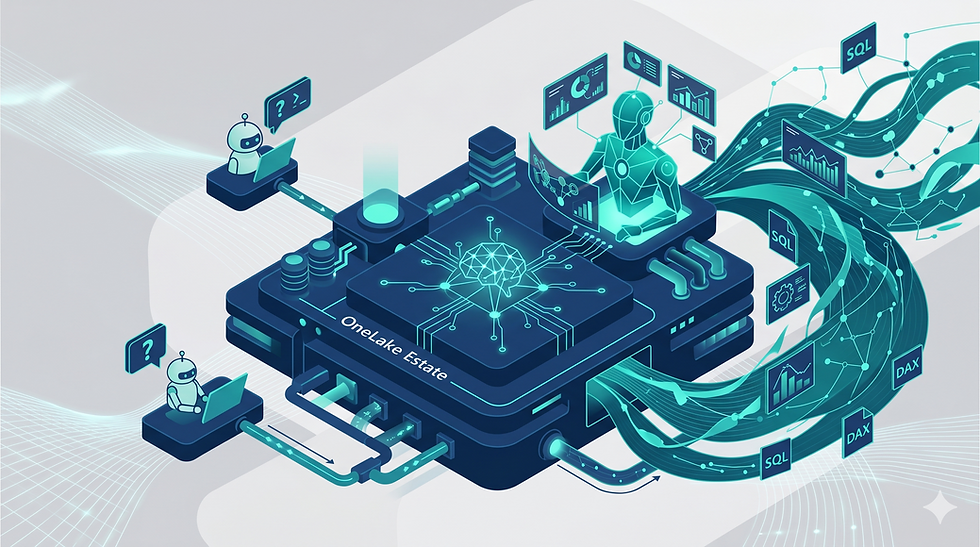
Your OneLake estate serves as the single source of truth for your organisation. By connecting Fabric Data Agents directly to your Fabric Lakehouses and Warehouses, you bypass the fragmented data silos that typically confuse and derail standard AI tools.
In a mature reporting environment, the agent sits directly on top of your unified, well-structured data architecture. It reads the underlying metadata, understands the relationships between fact and dimension tables, and knows exactly where to find the gross sales figures for Q3 versus the operational expenditures for the same period. This direct, native integration means the agent never has to guess where the authoritative data lives - it inherently knows, allowing for faster and far more accurate responses.
The Importance of a Business Ontology
Raw data without business context is practically meaningless. To prevent an AI from making wild assumptions or misinterpreting figures, it must understand your business ontology - the highly specific language, hierarchies, and rules unique to your organisation.
For example, how does your company explicitly define "Net Profit"? Does it include or exclude certain regional taxes, franchise fees, or depreciating assets? A well-configured Fabric Data Agent is deeply grounded in this ontology. It speaks your business language natively, ensuring that when a C-suite executive asks for a profitability breakdown, the agent uses the exact same definitions and logic as your internal finance team. This alignment is critical for maintaining trust in automated reporting.
The Security Layer: Eliminating Hallucinations

One of the biggest hesitations that data leaders harbour regarding Artificial Intelligence is the risk of "hallucinations" - instances where the AI confidently invents incorrect information. In a professional business context, acting on hallucinated financial or operational data can be catastrophic.
Read-Only SQL and DAX: The Foundation of Trust
Fabric Data Agents solve the hallucination problem through rigid structural constraints. Unlike standard generative AI models that essentially try to guess the next logical word in a sentence, these enterprise-grade agents interact with your data using read-only SQL and DAX queries.
When a user asks a complex question, the agent does not attempt to generate an answer purely from its vast internet training data. Instead, it translates the user's intent and generates a strict, read-only query. It runs that SQL or DAX query against your actual database, retrieves the concrete, factual numbers, and presents them to the user. Because the agent relies on deterministic querying languages to find the numbers - rather than generative text algorithms - the risk of numerical hallucination is practically eliminated. You are getting your actual database figures, simply retrieved via an intelligent interface.
Enforcing Row-Level Security (RLS)
Security and governance are paramount when deploying any form of virtual analyst. You simply cannot afford to have a junior team member inadvertently asking the AI for the CEO's salary or accessing confidential HR records.
Fabric Data Agents natively respect your pre-configured Row-Level Security (RLS) at the foundational level. Because the agent executes queries firmly on behalf of the authenticated user, the database applies the exact same security filters to the agent's query that it would if the user were running the report manually. If a regional manager in New South Wales queries the data, the agent will only retrieve and analyse data explicitly pertinent to the NSW region. The AI cannot bypass or outsmart your security architecture - it is completely bound by it.
Why You Need Specialist Setup for Virtual Analysts
The marketing and hype surrounding AI often promise a seamless "plug and play" experience. However, the reality of enterprise data analytics is far more complex and demanding. To successfully deploy Fabric Data Agents that actually deliver value, you require specialist, professional setup.
Engineering Proper Data Schemas
An AI agent is only ever as good as the underlying data model it sits on top of. If your data architecture is a chaotic mess of poorly named columns, circular relationships, and undocumented tables, the virtual analyst will inevitably fail.
Building an effective virtual analyst requires meticulously engineered data schemas, which typically include:
Logical Table Structures: Often adhering to strict Kimball methodology or a well-defined Medallion architecture (Bronze, Silver, and Gold layers).
Clear Relationships: Explicitly defined pathways between fact and dimension tables so the AI understands how datasets interact.
Intuitive Naming Conventions: Standardised nomenclature that removes ambiguity for both human users and virtual agents alike.
Establishing Prompt Guardrails
Even with read-only queries and strict RLS in place, you must establish robust prompt guardrails. A data specialist will rigorously configure the agent to handle complex financial or operational metrics correctly. They will train and constrain the system to recognise highly ambiguous requests and force it to ask the user for clarification, rather than making dangerous assumptions behind the scenes.
Without this expert calibration, an eager AI agent might misinterpret a nuanced request regarding "adjusted revenue" or "EBITDA," leading to skewed reporting and poor strategic decisions. This is exactly why you need seasoned professionals to guide the implementation and enforce the rules of engagement.
If you want to ensure your architecture is built correctly from the ground up, engaging expert Microsoft Fabric consulting is the most effective way to guarantee your virtual analysts deliver accurate, secure, and actionable insights. Specialists understand the nuances of the platform and know precisely how to construct the structural guardrails that keep your AI strictly on track.
Conclusion
The inevitable transition from standard Copilot features to dedicated Fabric Data Agents marks a fundamental shift in how modern businesses leverage their data. By moving away from passive prompts to autonomous, active AI systems, organisations can build powerful virtual analysts that truly understand the depth and context of their OneLake estate.
However, implementing this advanced technology requires respect and discipline. It demands unified data structures, stringent security measures like RLS, and a well-defined, universally accepted business ontology. Most importantly, it requires specialist data engineering to ensure the agent operates securely and accurately within your highly specific business context.
At Report Simple, we believe in doing data right. We cut through the hype to deliver concrete, automated reporting solutions that drive real business value. If your organisation is ready to explore the immense power of autonomous AI in your analytics workflow, it is time to look beyond the standard prompt. Start building a robust, secure data foundation today, and empower your teams with virtual analysts they can genuinely trust.