Microsoft Fabric vs. Azure Synapse: Is it Finally Time to Migrate Your AU Data Warehouse?


The Australian data landscape is currently facing a significant pivot point. For the last several years, Azure Synapse Analytics has been the "gold standard" for enterprise data warehousing. It provided the scale, the SQL pools, and the integration needed to handle massive datasets. However, the release of Microsoft Fabric has fundamentally changed the conversation.
As a Lead Content Strategist at Report Simple, I speak with dozens of AU-based IT managers and CFOs who are asking the same question: Is Azure Synapse already obsolete? The answer isn't a simple "yes," but the gravity of the Microsoft ecosystem is clearly shifting toward Fabric.
In this guide, we will break down the technical and financial realities of moving from Synapse to Fabric, helping you decide if 2026 is the year to modernise your data stack.
The "End of Life" Conversation: Reading Between the Lines
Microsoft rarely "kills" a product overnight. If your organisation is currently running on Azure Synapse, your dashboards won't simply go dark tomorrow. However, in the technology world, there is a distinct difference between "supported" and "innovated."
All current engineering momentum is focused on Microsoft Fabric. While Synapse remains a robust tool, it is effectively in a maintenance phase. For Australian businesses, this presents a long-term risk regarding support and talent acquisition. As the pool of developers shifts their focus to Fabric’s SaaS (Software as a Service) model, finding specialists to maintain legacy Synapse pipelines will become increasingly difficult and expensive.
The subtle shift is already visible in Microsoft’s documentation and roadmap updates. Fabric is being positioned as the successor that unifies the fragmented experience of Synapse. If your long-term strategy involves staying within the Microsoft ecosystem, ignoring Fabric is no longer a viable option.
Cost Comparison: Reserved Capacity vs. The F-SKU Model
One of the most significant changes in the move to Fabric is how you pay for compute power. This is often where Australian CFOs find the most value - or the most confusion.
Azure Synapse: The Reserved Capacity Approach
In the Synapse world, many organisations opt for Reserved Capacity to save money. You essentially pre-pay for a certain amount of Data Warehouse Units (DWUs) over a one - or three - year term. While this offers a significant discount, it is rigid. If your data processing needs spike, you might find yourself under-provisioned; if they drop, you are still paying for capacity you aren't using.
Microsoft Fabric: The F-SKU Consumption Model
Fabric operates on a "capacity-based" model using F-SKUs (Fabric SKUs). This is a more fluid, consumption-based approach. Key benefits include:
Smoothing: Fabric can "smooth" out bursts in activity. If a heavy query takes 15 minutes of high compute, Fabric can spread that cost over a longer period to prevent you from needing to jump to a higher, more expensive tier.
Pause and Resume: Unlike some older SQL pool configurations, Fabric capacities can be scaled or paused with far greater agility.
Unified Billing: You no longer have separate bills for your data factory, your compute, and your storage. It is all bundled into the capacity.
To ensure your infrastructure is correctly right-sized for this new billing model, engaging in professional Azure consulting is essential. Moving to an F-SKU model without a clear understanding of your current peak loads can lead to unexpected monthly "bill shocks."
The Migration Path: Why "OneLake" Changes Everything

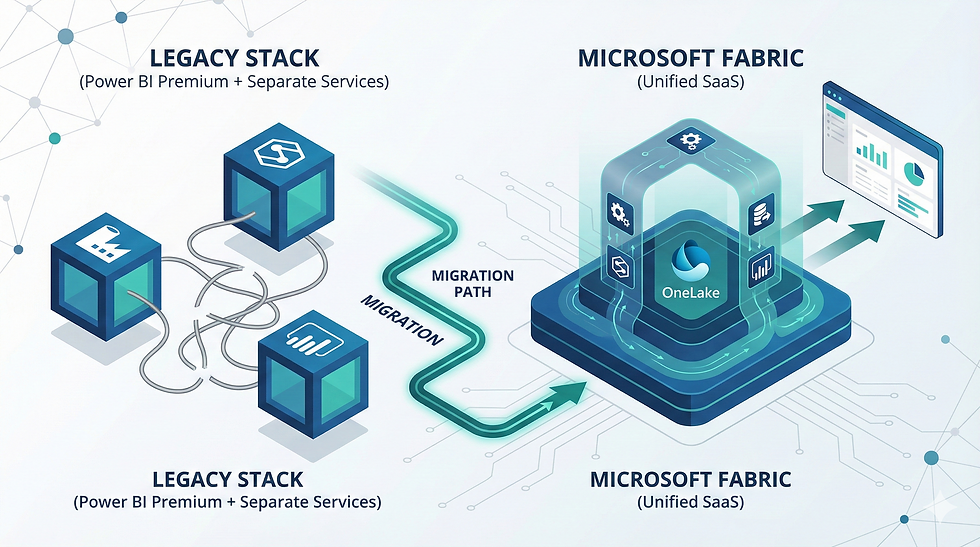
The most daunting part of any data project is the ETL (Extract, Transform, Load) process. Historically, moving a data warehouse meant physically moving petabytes of data from one "silo" to another. Microsoft Fabric attempts to solve this through "OneLake" - often described as "the OneDrive for data."
The Power of "Shortcuts"
OneLake allows for a feature called "Shortcuts." This allows Fabric to point to your existing data in Azure Data Lake Storage (ADLS) Gen2 or even Amazon S3 without actually moving the data. This "zero-copy" architecture is a game-changer. It means you can start using Fabric’s features (like Data Science or Real-Time Intelligence) on your existing Synapse data almost instantly.
Transitioning the Semantic Layer
While the data storage is easier to manage, the semantic layer and the reporting layer require a delicate touch. This is where your business intelligence actually lives. To maintain continuity for your end-users, leveraging expert Power BI consulting is vital. Since Fabric and Power BI are now essentially part of the same interface, the migration offers a unique opportunity to optimise your DAX queries and clean up "spaghetti" data models that have likely accumulated in your Synapse environment over the years.
The Hidden Trap: "Zombie" Resources
During a migration, many Australian organisations fall into the "Parallel Run" trap. They spin up a Fabric environment to test it, but they keep their Synapse environment running at full tilt "just in case."
Without a strict cutover plan, you end up paying for "zombie" resources - Synapse SQL pools that aren't being queried or integration runtimes that are still firing but sending data to a decommissioned destination.
A technical audit is the only way to prevent this. Before you move a single table, you should have a clear inventory of:
Active vs. Dormant Pipelines: Which data flows are actually used by the business?
Storage Redundancy: Can we use OneLake shortcuts to stop paying for duplicate storage?
Compute Requirements: What is the minimum F-SKU required to match our current Synapse performance?
Why a Specialist’s Hand is Still Required
On paper, Microsoft Fabric is "SaaS-ified" data warehousing. It looks easy - like opening a new Word document. But the reality of enterprise data is never that simple.
Fabric is still a young product. There are nuances in how "Direct Lake" mode works compared to traditional "Import" or "DirectQuery" modes in Power BI. There are also specific security and governance considerations, particularly regarding how Australian data sovereignty laws apply to the unified OneLake architecture.
A specialist consultant doesn't just "move" your data; they re-architect it for the future. They ensure that your workspace permissions are tight, your Delta Parquet files are optimised for performance, and your team knows how to use the new "Copilot" features effectively.
Summary: Should You Migrate Now?
The decision to migrate from Azure Synapse to Microsoft Fabric should be based on three factors:
Your Innovation Cycle: If you are planning a major refresh of your reporting suite, do it in Fabric. Don't build new projects in Synapse.
Your Budget Flexibility: If you are tired of the rigid "Reserved Capacity" model and want more granular control over your spending, Fabric’s F-SKUs are superior.
Your Technical Debt: If your current Synapse environment is messy, a migration is the perfect "clean slate" event to fix your data governance.
For most Australian organisations, the "wait and see" period for Microsoft Fabric is over. The platform is stable, the performance is proven, and the cost benefits are clear when managed correctly.
Is your organisation ready to trade legacy complexity for a unified data future? At Report Simple, we specialise in helping Australian businesses navigate these transitions without the downtime. Whether you need a deep-dive audit of your current Azure environment or a strategic roadmap for a Fabric rollout, our team is here to help. Contact us today to discuss how we can streamline your reporting and turn your data into a genuine competitive advantage.